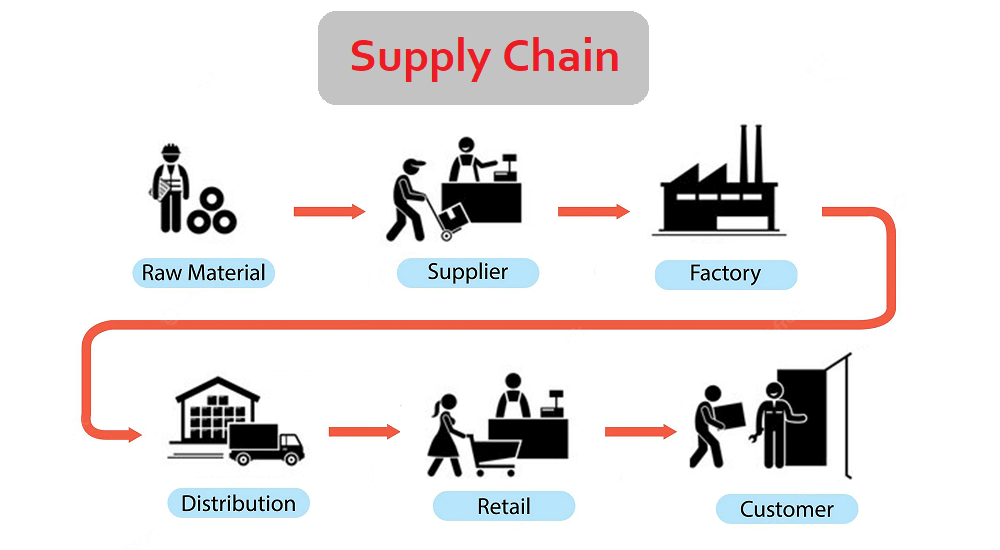
Transportation refers to the movement of product from one location to another. Products manufactured by companies are rarely produced and consumed in the same location. Hence transportation plays an important factor.
Key Learnings:
- Align transportation strategy with competitive strategy
- Consider both in-house and outsourced transportation
- Use technology to improve transportation performance
- Design flexibility into transportation networks
Transportation comprises a significant cost component, especially if it’s a global company.
Useful Terminologies in Transportation:
- Shipper is the party that requires the movement of the product
- Carrier moves or transports the product e.g., UPS, Fedex, DHL
- Consignee is the party shown on the bill of landing or air waybill to whom the shipment is consigned
Modes of Transportation
Modes of Transportation: Air, Package carriers, Truck, Rail, Water, Pipeline, Intermodal.
Air is the fastest mode and often used for global transit of expensive items. Its cost components are: Fixed infrastructure and equipment, Labor and fuel, and variable depending on passenger/cargo. Key issues in using air transport include prices and availability.
Package Carriers usually carry small packages up to about 150 pounds. While they are expensive, they ensure rapid and reliable delivery and are a great choice for small and time-sensitive shipments. The also provide other value-added services such as package tracking.
Truck: Significant fraction of the goods are moved using Trucks.
- Truckload (TL) is great for large loads (Average haul = 274 miles). It has low fixed and variable costs. Major issues include lack of consistent service and Backhauls (especially when economies of scale are missing).
- Less than truckload (LTL) is typically used for smaller shipments (Average haul = 646 miles). It has higher fixed costs (terminals/consolidation centers) but low variable costs. Location of consolidation, Facilities Utilization, Vehicle routing, IT complexities and Customer service can be the major issues.
Rail is typically used for moving commodities over large distances. This mode entails high fixed costs in equipment and facilities. It can be scheduled to maximize utilization. However Transportation time can be long.
Water transport involves moving goods through Oceans, inland waterway systems, coastal waters. Companies can transport very large loads at very low cost and is a dominant mode in global trade. However, this is the slowest mode and it is also limited to certain geographic areas. IKEA makes very strong use of water and other low cost transport.
Pipeline: It is primarily used for crude petroleum, refined petroleum products, natural gas. It has high fixed cost and is best for large and stable flows with predictable demand.
Intermodal is the use of more than one mode of transportation to move a shipment. Example, combination of truck and rail. This mode has grown considerably with increased use of containers. It is more convenient for shippers. Key issues include exchange of information to facilitate transfer between different modes.
Transportation Strategies
Transportation requires clever strategies. For example:
- Ikea and flat packs
- Seven-eleven in Japan and aggregation plus frequent deliveries/responsive system
- Seven-eleven annual inventory turnover rate is 50 in Japan (19 in the U.S.A.)
Governments generally take full responsibility or played a significant role in building and managing infrastructure elements. Without a monopoly, deregulation and market forces help create an effective industry structure.
Transportation Network
When designing options for a Transportation Network, the objective is to achieve desired levels of responsiveness at a low cost.
Key questions to be asked include: whether transportation should be direct or through an intermediate site? Should the intermediate site stock product or only serve as a cross-docking location? Should each delivery route supply a single destination or multiple destinations (milk run)?
Here are the various network structure with their Pros and Cons:
Direct Shipping: This structure does not require intermediate warehouse and is simple to coordinate. However, it requires high inventories (due to large lot size).
Direct shipping with milk runs: This structure incurs lower transportation costs for small lots and requires lower inventories. However, it requires increased coordination complexity.
All shipments via central DC with inventory storage: In such a design, suppliers send their shipments to a central distribution center where the shipments are stored until needed by buyers. The shipments are then shipped to each buyer location. Example: Coke’s DC and its role in replenishing stores. This structure incurs lower inbound transportation cost through consolidation.
All shipments via central DC with cross-dock: In such a design, suppliers send their shipments to an intermediate transit point. They are cross-docked and sent to buyer locations without storing them. Goods do not stay in transit point for too long typically (usually less than 24Hrs). Example: Walmart. This structure has low inventory requirement. There is lower transportation cost through consolidation.
Shipping via DC using milk runs: This structure incurs lower outbound transportation cost for small lots. However, there is further increase in coordination complexity.
Tailored network: Transportation choice best matches needs of individual product and store. However, this structure has the highest coordination complexity.
Trade-offs in Transportation Design
When selecting a mode of transportation, managers must account for unit costs and cycle, safety, and in-transit inventory costs that result from using each mode.
Modes with high transportation costs can be justified if they result in significantly lower inventory costs.
Transportation and Inventory Cost Trade-off
Inventory aggregation decisions must account for inventory and transportation costs.
Inventory aggregation decreases supply chain costs if the product has a high value-to-weight ratio, high demand uncertainty, low transportation cost, and customer orders are large.
If a product has a low value-to-weight ratio, low demand uncertainty, large transportation cost, or small customer orders, inventory aggregation may increase supply chain costs.
Transportation Cost and Customer Responsiveness Trade-off
High responsiveness results in high transportation costs whereas decreased responsiveness results in lower transportation cost.
Temporal aggregation refers to combining orders across time. Temporal aggregation of demand results in a reduction of transportation costs because it entails larger shipments and reduces the variation in shipment sizes from one shipment to the next. It does, however, hurt customer response time. The marginal benefit of temporal aggregation declines as the time window over which aggregation takes place increases.
Tailored Transportation
Tailoring transportation based on customer density and distance, customer size, or product demand and value allows a supply chain to achieve appropriate responsiveness and low cost.
Role of IT in Transportation
The complexity of transportation decisions demands use of IT systems. IT software can assist in: Identification of optimal routes by minimizing costs subject to delivery constraints, Optimal fleet utilization, GPS applications.
Some of the benefits include electronic notifications, real time tracking, re-routing in case of disasters.
Related:

BATheories.com is managed by a group of educators from Mumbai. We also manage the website AcademicsHQ.com. Our panel includes experienced professionals and lecturers with a background in management. BATheories is where we talk about the various business theories and models for BA (Business Administration) students.